Original article with beautiful photos in Daily Maverick
By Tristen Taylor, Jiyoon Kim, Ingrid Gercama and Nathalie Bertrams
In 2024, about half a million tonnes of krill was hauled out of the Antarctic, with Norwegian, Chinese and South Korean boats taking the vast majority of the catch. What would happen if the krill disappeared?
Pohang, South Korea – Sunset washes the harbour in pretty light, a spectrum of purples and pinks hit the Posco steel works, dark clouds of an approaching storm behind. And all long the breakwater retirees and families cast their lines. On occasion, a small fish, so small that it hardly seems worth the effort, is landed. The bait? Krill from the Antarctic.
The tiny crustaceans, only two to six centimetres long, are at the very base of the Antarctic food chain. Penguins, baleen whales, seals and seabirds all eat krill and in vast quantities. Crabeater seals feed almost exclusively on krill and live in Antarctica. They consume around 80 million tonnes of krill in total every year. A single adult humpback whale requires three tonnes a day.
But if the krill were to disappear, there wouldn’t be much left in the Antarctic except melting ice and microplastics. Krill are that important.
Daily Maverick and the Korea Centre for Investigative Journalism meet Eun-hee Kim in an open-planned office, divided by chest-high bookshelves, in Seoul. Kim’s a specialist in Antarctic fisheries and she says that “In my personal opinion, we don’t need krill. We cannot eat krill because of the fluorine in their shells. We don’t consume krill, then why do we need krill fishing?”
But fish it hard we do and not just for anglers’ recreational pleasures.
Last year, about half a million tonnes of krill was hauled out of the Antarctic with Norwegian, Chinese and South Korean boats taking the vast majority of the catch. Krill is primarily used for luxury goods. Salmon are fed krill to make their flesh turn pink, a colour consumers want, and factories transform the crustaceans into omega-3 products. A bit of the catch goes into pet food. The global krill oil market is estimated to be worth at least U$3.6 billion by 2036.
The current fishing season opened on 1 December 2024 and the boats are steaming in, now enabled to catch even more krill than before. The Convention for the Conservation of Antarctic Marine Living Resources (CCAMLR), an international body set up in 1980 to protect the Antarctic ecosystem has devolved into geopolitics and bloc mentality. History may look back at a critical CCAMLR meeting in October as the point of no return. And South Africa and South Korea were there as voting members.
A magic number in a sea of uncertainty
The story of krill fishing starts in 1946 when the whaling boat Slava left the Black Sea port of Odessa on a course for the Antarctic. Surrounding the Slava was a fleet of smaller ships armed with harpoons. It was the first time the Soviets went off whaling that far.
The slaughter started immediately, 386 whales were caught. Five years later, the crew of the Slava wrote a letter to Joseph Stalin promising to bring back the oil from 2000 whales. The massive expansion came in 1959 with the addition of five more fleets. Moscow set a quota and captains and crews that didn’t meet it were punished. Those who exceeded it were rewarded with bonuses and awards. Next year’s quota was set at the rate exceeded.
An inspector of a Soviet whaling fleet in 1968 wrote that “No reprimands, warnings, fines and reports (written and verbal) could slow down the unrestrained killing of undersized whales and lactating females, because otherwise the plan target would not be met.”
The strange thing was the USSR didn’t know what to do with all the catch. They only used about 30% of a whale, the Japanese used 90%. Fulfilling Moscow’s unscientific quota was all that mattered. By the time the Soviets were done, abandoning whaling in 1986, they had caught 338,336 whales. The Antarctic was empty.
Not quite content with the whales themselves, the Soviets experimented in 1961 with catching their food, four thousand tonnes of Antarctic krill caught. They set up a permanent fishery in 1972. Before the USSR’s interest, no one had ever fished for krill in the Antarctic. It was a long way to go to catch something with no clear use and under difficult conditions. The South Atlantic is rough water and terrible weather.
According to the Food and Agriculture Organisation’s 1996 history of the krill, the catch reached “a peak in 1982 when 528 201t were landed, 93% of which was taken by the Soviet Union.” Japanese, Chilean and Polish boats caught the rest. South Korean trawlers arrived in 1986.
In response to rising krill catches, CCAMLR was formed to manage the fishery. South Africa was a signatory on the basis that we were a founding member of the 1959 Antarctic Treaty, the overarching legal framework under which CCAMLR is located. The organisation’s first task was to set a precautionary conservation quota, as opposed to the USSR’s extermination quota.
Based off a 1980/1981 acoustic study of krill stocks in the South Atlantic and according to the FAO, a precautionary limit of 620,000 tonnes for the fishing area was set in 1991. This quota remains today, unchanged for the past 34 years.
Phil Trathan, a retired member of the British Antarctic Survey, says of the quota, “it’s a kind of magic number that has relatively little scientific basis…the fishery is a data poor fishery.”
The area of fishing is too large with not enough monitoring sites to have, in his opinion, enough hard data to be sure of the quota’s current validity. His rough and ready estimate is that it would take millions of dollars to conduct the appropriate surveys.
CCAMLR’s total 2025 budget is US$6,952,408 of which US$4,673,307 is allocated to salaries, US$583,598 to meeting facilities and US$170,000 for travel. Then there are audit, printing, equipment costs, etc.. Like the rest of CCAMLR’s 27 member countries, South Africa makes a contribution: US$158,212 which is about the average national contribution.
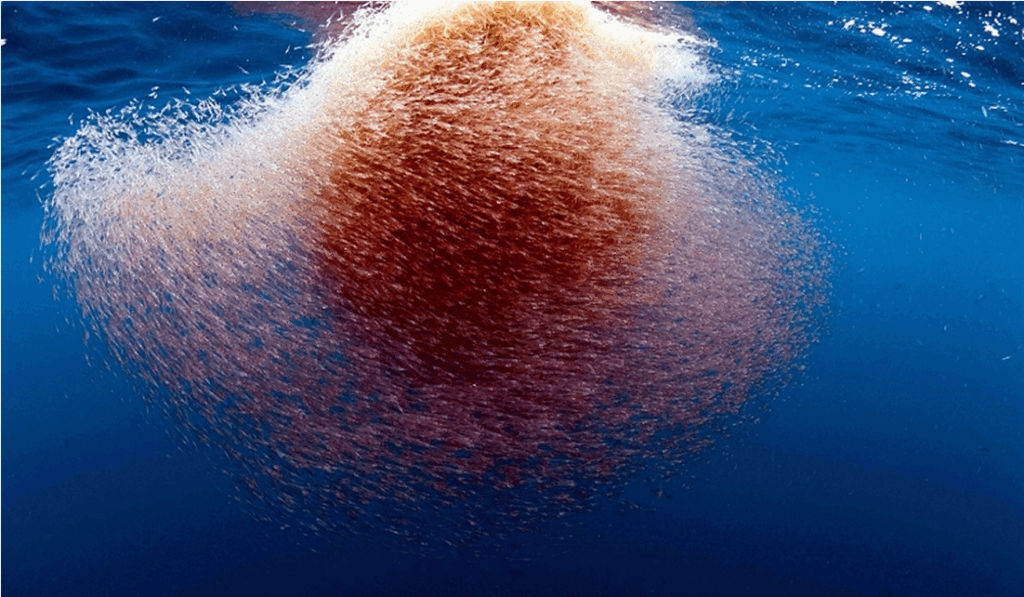
While the total stock of Antarctic krill is estimated at 215 million tonnes, the quota applies to the area where krill fishing is economically viable. This 3.49 million km2 area stretches from the South Georgia and the South Sandwich Islands in the north, past the South Orkney Islands and down to the Antarctic Peninsula where the majority of the fishing is concentrated. When krill get close to the ice shelf, they cluster in dense swarms with up to 30,000 of the crustaceans in a single cubic metre. The density can colour the ocean pink.
To find the krill in this area, the trawlers can follow the whales. Because of the swarming, that’s where the whale, seal, penguins and birds feed. So what really matters for the ecosystem is the localised impact of the fishing. The boats and Antarctica’s unique creatures are competing for the same resource.
Ryan Reisinger at the University of Southampton conducted research on krill in the Antarctic last year and he’s concerned about the 620,000 tonne quota. He says, “I think it’s very risky to catch to that limit. We can see it in maps of where people fish, a lot of that catch would be taken in very small areas, which leaves very little krill for other things like whales.”
Additionally, there are the annual variations in the krill biomass, something that also worries Reisinger. He points out that “In a given year, you might be fine. There might be the standing stock…but in another year which is krill poor, we might be completely overfishing, which leaves nothing left for other predators.”
And to put the current total krill stock into perspective, Matthew Savoca, a marine biologist at Stanford University, wrote in a recent multiple authored study in Nature that “In the Southern Ocean alone, we calculate that pre-whaling populations of mysticetes [baleen whales] annually consumed 430 million tonnes of Antarctic krill (Euphausia superba), twice the current estimated total biomass of E. superba.”
Savoca and his fellow authors are wisely avoiding what the eminent fisheries expert, Daniel Pauly, termed the shifting baselines syndrome. What’s been happening is that each generation of marine biologists judges the reduction in fish stocks on the state of affairs at the beginning of their careers, not the state of affairs before industrialised fishing. The result is, according to Pauly, “a gradual accommodation of the creeping disappearance of resource species.”
The health of the Antarctic ecosystem should be judged not by the state of play today but what was before the Soviets went all xenocidal.
After the Soviet Union disintegrated in 1991, krill fishing went out of fashion and during the 1993/4 season only 83,962 tonnes were caught, far below the 620,000 tonne precautionary limit. Krill and the rebounding whale populations were free to return to their mutually beneficial relationship. Recent research by Victor Smetacek at the Alfred Wegener Institute and Steve Nicol of the Australian Antarctic Division suggests that whale faeces promotes the growth of phytoplankton, which krill consume. More whales, the more for krill to eat, leading to more whales. As long as the ratio between increasing krill and whale populations remains in balance, everything is copacetic.
Then came the Norwegians.
Crazy brutal economics
From 1995 to 2005, the average annual catch of Antarctic krill was 109,395 tonnes with the main fishing nations being South Korea, Japan, Ukraine and Poland. Everything changed when Norway entered the game. Aker BioMarine, a Norwegian company, arrived in the South Atlantic in 2006 and began fishing, using not traditional nets but what is essentially a giant vacuum to suck up the krill.
Since Aker BioMarine’s entrance, the catches have increased dramatically. The 2023 fishing year is illustrative of the Norwegian era. Of the total catch of 424,203 tonnes, South Korea accounted for 8.4%, China 17.1%, Ukraine 2.8% and Chile 4.4%. Norway hauled in 285,132 tonnes, 67.2% of the total.
While the official figures for last year’s catch have yet to be released, CCAMLR gave a projection in October, stating that the current krill catch “was more than 498 000 tonnes…and may exceed 500 000 tonnes by the end of the 2024 season.” In other words, the krill fishery has just about returned to where it was at the peak of Soviet fishing.
Aker BioMarine’s five-story headquarters in Oslo looks like a glass iceberg. After months of back and forth emails, the company finally agreed to an interview in September 2024. The meeting room is decorated to conjure up ocean depths. Blue walls and lamps resembling floating jellyfish. On a wall-mounted television, a humpback whale swims to save the screen.
Pål Skogrand, the sustainability manager, turns off the flatscreen. Perhaps he’s worried about the optics. Aker BioMarine’s most advanced ship, the Antarctic Endurance, hauled up a juvenile humpback whale at the beginning of 2024. Retrofits to the nets to prevent such by-catch hadn’t yet been installed.
On questions about whether there are localised impacts on whale populations or if the krill fishing quota should be increased, Skogrand points out that is CCAMLR’s job. He says “I think that what matters is not really what we think. What matters is what the scientific community thinks.”
Skogrand also lays out how the value chain works. Aker BioMarine boats harvest krill and process it into meal on board. From the company’s warehouse in Montevideo, Uruguay, the krill meal is sold as feed for aquaculture, particularly for salmon farming, or is sent to the company’s processing facility in Houston, USA to be converted into krill oil for omega-3 pills.
“You have the unique composition of krill that makes it interesting,” Skogrand says. “You know, you wouldn’t go to the other side of the world if it wasn’t interesting. If you couldn’t [have] used it for something.”
According to Aker BioMarine’s 2023 annual report and in terms of revenue, krill oil brought in US$190.6 million, krill meal US$133 million and “Qrill™ Pet and other products” generated US$5.9 million.
But the strange thing is that Aker BioMarine doesn’t seem to be earning a profit. The company’s annual reports from 2012 to 2023 show a string of net losses. The total net loss during this period was US$124.6 million and only two years showed net profit.
So it’s a long way to go to the Antarctic not to make money.
Last year saw Aker BioMarine make significant changes. One was to discontinue and put up for sale its Understory project, which sought to turn Antarctic krill into a protein source for human consumption.
According to Aker BioMarine’s third and fourth quarter reports for 2024, the main change was selling off its krill harvesting and feed operations into a new company, Aker QRILL Company, with a US private equity company taking a 60% stake and Aker Capital, the parent company, the remaining 40%. The US$569 million sale of roughly half of Aker BioMarine’s assets, by dollar value, landed it with a 2024 net profit of US$181 million. So the company bailed before, in all likelihood, future yearly losses ground it down.
By the end of 2024, Aker BioMarine became just a krill oil and supplements manufacturer: it’s out of the krill fishing and feed game.
Some of American Industrial Partner’s investments include energy companies, a defence contractor, an aluminium smelter, a fleet of ships servicing the aquaculture industry, a grain equipment manufacturer and a paint company. Aker QRILL and Aker BioMarine signed a feedstock supply agreement last year.
So the Americans are now back to fishing for krill, which is a bit odd. In 2009, krill fishing was banned for 200 nautical miles off the US’s western coast to ensure enough food for whales and other creatures.
Logan Pallin is a marine biologist at the University of California and independent of CCAMLR. He has a slightly different take than Skogrand, saying, “Going all the way to the Southern Hemisphere to vacuum out the keystone species to this food web to then ship it back to the North and turn it into meal for salmon, pet food, and omega-3 pills makes no sense.”
Back in Oslo and as the interview was drawing to a close, Skogrand warned Daily Maverick that, “Sometimes you have whale scientists talking about krill, stuff that they have no idea about.”
Maybe he was thinking of Pallin or he might have been thinking of Matthew Savoca.
“So it’s just like the silliest thing in the world,” Savoca told Daily Maverick in December. “You have these giant boats burning fossil fuels, coming from Norway, coming from China, coming from South Korea, coming from the other end of the world to go harvest food that whales and penguins and seals need to then turn into stuff to just make our salmon pink. It’s just, like, the absolute craziest thing. I mean, it’s so crazy.”
Savoca and Pallin are wrong about one thing. Krill fishing gets even weirder.
Don’t ask, don’t tell
When investigating fishing in general, the first thing you’ll run into is a wall of silence. Governments and companies don’t want to talk. Retailers are skittish. Fishermen bitterly suspicious.
All of which makes sense in a way for the health of the planet’s oceans is terrible and overfishing is the prime cause. According to the Food and Agriculture Organisation’s flagship report on the oceans, The State of World Fisheries and Aquaculture 2022, only 7.2% of all fish stocks aren’t either overfished or extracted to the maximum of sustainability. In 1974, ten percent of stocks were overfished, by 2019 that figure had risen to 35.4%.
Since we’ve pretty much maxed out the oceans and especially the higher trophic predators, people have turned to aquaculture. The production of farmed salmon, especially in Norway and Chile, has been meteoritic. In 2000 and according to the FAO, global production was 900,000 tonnes. By 2023, it was 2.8 million tonnes. Aquaculture’s salmon need to eat, so fish in cages are fed wild-caught marine organisms. Stuff like anchovies, sardines and krill.
Salmon farming doesn’t reduce the pressure on the oceans, it exacerbates the strain and is set to do so far into the future. Norway’s national ambition is to produce five million tonnes of salmon by 2050, which will demand a lot more of the tiny crustaceans that the Adélie penguin needs to survive and more of the pelagic fish we do eat.
None of this is a secret but it is a pretty unpleasant truth. Hence, the wall of silence.
The Russian and Chinese embassies in Pretoria didn’t respond to requests for comment. The Korean fishing conglomerate, Dongwon Industries Co. Ltd, declined to be interviewed. Aker BioMarine refused to comment on its huge financial losses. When Daily Maverick asked CCAMLR to attend its July 2024 meeting in Incheon, South Korea, we were informed that the press was barred.
The South African retailers Pick n Pay and Checkers refused to say whether the farmed salmon on their shelves was fed with krill. The other major South African supermarket chain did answer questions. Woolworths stated that their salmon was krill free, which rather does prove the point that salmon farming doesn’t necessarily need krill. With a retail price tag of about R780 per kilo, the point is also made that portions of Norwegian salmon aren’t going to solve world hunger.
Jeong-hoon Kim is a researcher at the Korea Polar Research Institute, a collection of large but eerily quiet buildings in Incheon, and an official member of Korea’s delegation at CCAMLR. He’s very happy to explain, standing in front of diagrams of the Antarctic ecosystem, how krill play a vital role in taking carbon dioxide out of the atmosphere.
And it’s pretty simple. Phytoplankton absorb carbon dioxide from the air. Krill eat the phytoplankton. Some of the carbon dioxide is then locked up in krill faeces and exoskeletons, which fall to the ocean floor and thus sequester the carbon dioxide. So the less krill there are, the less carbon dioxide gets sequestered and the more global warming we will have.
Kim also says that, “It is thought Antarctic krill is declining in Antarctica due to a variety of factors, most notably global warming and changes in the ocean environment.”
Useful to know but Kim wouldn’t talk about what was going down at CCAMLR. He wouldn’t even talk about the ecosystem sustainability of the krill fishery. A plain refusal, another brick in that silent wall.
But there was someone who did talk. A most unusual source. The CEO of what is arguably the world’s most technologically advanced manufacturer of krill oil.
When a fad goes bust
Juwan Noh is a man who loves his job. He looks excited that a pair of reporters have travelled four hours from Seoul, at the beginning of October 2024, to talk about krill oil. The outside of BioCorp’s headquarters, Noh is the CEO, doesn’t look like much. A white building in a nondescript area of warehouses and factories. But from the first floor office space, you can look through an internal window at manically clean tanks and pipes where the processing of krill and other feedstocks happens.
“So, we’re not specialized in krill oil but we’re specialized in extraction,” Noh says. From the raw material, BioCorp extracts krill oil, which contains two forms of omega-3 bound to phospholipid molecules. The forms of omega-3 are eicosapentaenoic acid (EPA) and docosahexaenoic acid (DHA) and the higher the phospholipid content, the more EPA and DHA.
BioCorp can go up to 61% phospholipid content in its krill oil, higher than Aker. One of the great things for Noh is that there is no by-product from the extraction, the ‘waste’ is sold as meal for aquaculture.
Noh explains that krill oil “has less EPA and DHA than fish oil, but it’s a lipid, emulsifier type, so it’s very well absorbed when you eat it. So when people eat it, they don’t have that fishy smell that people in Korea are not very sensitive to. When you eat it and burp it, the fishy smell doesn’t come up because it’s well absorbed. That’s why it was popular in North America.”
And krill oil used to be popular in South Korea. Very.
Krill products was a major hyper fad in South Korea at the end of the 2010s: a plethora of pills, creams, K-beauty products and even a detergent for washing dishes. The country went krill nuts. Scandal hit in 2020 when the government withdrew a number of krill products because they contained solvents, such as ethoxyquin and hexane, in excess of approved standards. Consumers scattered.
At the time, the Ministry of Food and Drug Safety put out the following statement: “Krill oil is not a health-functioning food but a general food, so we urge you not to be misled by false or hyped advertising without medical or scientific grounds such as disease prevention and treatment effects.”
“The fad is over,” Noh says, “so the orders are gone and the market is less than one-twentieth of what it was then, to be honest with you. We don’t have any domestic at all. Everything we do now is 99% export.”
“I can’t do it cheaper than the Chinese,” Noh also points out. “A little more expensive than the Chinese but cheaper than companies from countries that don’t catch krill. It’s more of price competition on labour cost. In the past, before we started, there were companies that made krill oil globally, like Aker BioMarine, then Neptune, then Rimfrost. But they’re all gone. They either went out of business or Aker acquired them all….So it’s just Aker, China and there’s one in New Zealand.”
Noh credits BioCorp’s survival in the market to its lack of reliance on krill. Of the company’s R540 million total sales, krill only accounts for R26 million. He predicts that sales are “going to be less than last year because krill oil is not that big of a percentage of our sales and we don’t care if they change to something other than krill. We’re just going to go with it.”
Perhaps that’s why Noh is open to talking about the krill market and what appears to be some pretty harsh economics. Just like Aker BioMarine, the Korean fishing companies appear to be having problems with the economics of krill fishing.
Noh suspects that Korea’s krill fishing industry wouldn’t have made money from krill fishing, stating that “We only need a fraction of what they catch. Our purchase is not much of a help for them.” He also says that, “The fisheries have a vessel, so they catch krill. The fisheries face a loss but maintain fishing for future value.”
Dongwon Industries and Jeongil Corporation are currently running one krill trawler a piece. According to Jeongil’s founder Park In-sung’s 2011 autobiography, the company joined CCAMLR as an advisor to the South Korean delegation in order to expand its operations into the Southern Oceans.
Jeongil started fishing krill in 1999. Park made large investments in diversifying the use of krill beyond bait, including for human consumption. Jeongil ended up abandoning that project as the economics of krill for humans didn’t work out, as did a project to reduce fluorine in shells.
In written responses to the Korea Centre for Investigative Journalism’s questions on the profitability of krill fishing, Jeongil Corporation confirmed the poor economics of krill fishing. The company stated that “The scale of our krill sales is 1% of the total in 2024, so the impact on sales is minor,” and that “Like the aforementioned Aker, we have also been operating at a continuous long-term deficit. So from 2022, we reduced the number of fishing vessels [in the Southern Ocean] from two to one, and implemented a policy of minimised fishing since 2023.”
Dongwon’s annual report for 2023 doesn’t disaggregate its different fishing operations and Dongwon refused to talk to the Korea Centre for Investigative Journalism about the profitability of its krill fishing business.
The wisdom of South Korea exporting some of the krill it catches to Japan, Taiwan and China for bait is very much in doubt. As fisheries expert Eun-hee Kim told Daily Maverick in Seoul, “Since krill are creatures that play an important role in the Antarctic ecosystem for many predators, such as penguins and whales, I question as to whether we should go all the way to the Antarctic Ocean to catch krill for nutritional supplements or fishing bait.”
But scientific warnings and terrible economics aren’t holding back the People’s Republic of China. Noh states, “Around 2015, I heard that the Chinese government launched a policy drive to find a new good source of protein for people.”
Creating a huge market from thin air
Liu Shenli, the chairman of the China National Agricultural Development Group, stated back in 2015 that the “Antarctic could provide almost 100 million metric tons of krill products annually, equal to the world’s current fishing output, and China should aim to harvest one to two million tons.”
Last year, China harvested 72,591 tonnes, a tad off from its goal to desertify the Southern Oceans. But in 2009, when the country started fishing for krill, the catch was 1,956 tonnes. China now has three boats and is actively trying to create a domestic market for krill.
However and according to Nengye Liu’s 2019 journal article The rise of China and the Antarctic treaty system?, “Chinese krill fishing is not profitable, which becomes a hurdle for Chinese fisheries companies to conduct the business.”
Shanghai Kaichuang Marine Int’l Co., Ltd. (SKMIC), one of the two companies that started China’s Antarctic krill fishing in 2009, serves as a case in point.
Tabitha Mallory, an expert on China’s krill fishing and an affiliate professor at the University of Washington says of SKMIC in 2015 krill revenue was “CNY 11.449 million (USD 1.74 million) while the costs were CNY 46.32 million (USD 7.06 million), meaning a gross margin of minus 305 percent. The company sold krill meal in 2016 and 2017, but still operated at a loss for krill products. SKMIC thus left the krill business in 2018.”
The answer to krill not being profitable has been subsidies, large ones. According to the China Ocean Institute, in 2016 China’s ministry of agriculture set new subsidies for distant-water boat construction and refurbishment. Krill boats received the highest subsidies: R380 million per boat for new Antarctic krill fishing and processing vessels, R76 million to refurbish an old one. Additionally, there are soft loans for construction, fuel subsidies and local government support.
From 2020 to 2025, China put to sea four new boats and now has the largest Antarctic krill fishing fleet in the world. China stated in 2024 that the krill quota should be increased to 668,101 tonnes.
Bettina Meyer is a scientist at the Alfred Wegener Institute in Germany and a member of CCAMLR’s scientific committee. She states that “the Chinese say to me that something has to be done somehow, because China is now building five new krill ships.” She also says that it is necessary to “look at the scientific data and act accordingly and not because you are building five or six ships. But that’s exactly the point they’re making.”
Information on current subsidies is scarce. That said, the current 14th Five-Year National Fishery Development Plan, states: “General transfer funds will be used to subsidize offshore fishing vessels…and other expenditures coordinated by localities for fishery development and management.”
Mallory says that and while stressing the need for research into the current period, “krill is probably still growing and receiving some of the highest subsidies compared to other stocks/regions. And it’s highly likely it’s not profitable without the subsidies.”
Browsing through the online retailers Alibaba and Made-in-China reveals all manner of krill products. Apart from the usual omega-3 pills, there’s frozen and dried krill for pets: food, snacks and supplements. Qingdao Kangjing Marine Biotechnology Co, a strategic partner of the state-owned China National Fisheries Corporation, sells frozen krill in bulk. The minimum you can order is 10 tonnes at between US$1,060 to US$1,210 per 25 kg. Shipping excluded.
Dalian Gaishi Food Co goes a couple steps further, advertising “High Quality Exquisite Freshness Krill Sashimi Sushi Raw Fish Ideal For Luxury Sushi Events And Gourmet Evenings”. Minimum order of 1000 kg at between US$9 and US$11 per kg. Shipping to be negotiated.
And that was the situation at the beginning of October 2024: krill to turn luxury salmon pink. Krill oil for omega-3 pills that study after study shows no health benefits, after all South Korean consumers deserted in mass and it’s not like an epidemic of omega-3 deficiency is blighting the country. There doesn’t seem to be all that much money in the trade. A quota set 34 years ago. Boats fishing at Soviet levels. And China trying to convince the population that krill is tasty.
Then CCAMLR, at a meeting in Australia in the middle of October 2024, made everything so much worse.
A seminar at the end of the world
Sunshine occasionally pokes through grey clouds hanging over Punta Arenas, at Chile’s southernmost tip. The cold rain and strong wind come and go. Tourists prepare for Antarctic holidays and there’s a krill fishing boat in the harbour. End of November, ten degrees centigrade, and the place is in the grips of a summer heatwave.
César Cárdenas, the head of CCAMLR’s scientific committee, is a hard man to pin down. Email after email failed to get an online interview. So, Daily Maverick decided to doorstep him at a scientific seminar on krill at the Chilean Antarctic Institute, located next to Punta Arenas’s central plaza.
The presentations at the sparsely attended seminar were sobering: krill had moved southwards due to climate change and ice loss, in other words habitat shrinkage, and there’s been a reduction in krill population density. Microplastics affect the ability of krill to feed and reproduce. Scientific management and strict regulation of the krill fishery is absolutely necessary to prevent overfishing.
So Kawaguchi’s presentation, he’s a krill ecologist from the Australian Antarctic Division, on the impacts of ocean acidification on krill populations in the Southern Oceans was particularly sombre: the successful hatching of krill eggs could decline by more than 50% by the end of the century if emissions aren’t mitigated. He also pointed out that the conditions of a high CO2 world are not sustainable for krill.
During the Q&A session after Cárdenas’s presentation, Daily Maverick asked him for an interview. He could hardly say no, the seminar being streamed live on YouTube.
Cárdenas is, like Phil Trathan, worried about the data on the fishery. He says that we “need to know more about krill. Basically we have some studies, we have experimental. It’s experimental, the modelling. It also has a lot of gaps because the models are fed with data and it’s not necessarily the best. So that’s why [there] needs to be a big improvement in terms of the information that we collect.”
He also mentions that there isn’t much data on what happens in winter and that there are new factors that have developed since the 620,000 tonne quota was set. He says, “We know there are some years that have less krill than others and we have more whales. And we might have more vessels in the future.”
The purpose of CCAMLR’s scientific committee is to provide data on the krill fishery to the decision makers, CCAMLR’s Commission which is composed of the governments of 26 nations plus the European Union. The Commission makes decisions on a consensus basis. One of the ideas put forth by scientists is that marine parks, where no fishing is allowed, should be created to protect krill populations. The creation of a marine park would require all of CCAMLR’s members to agree.
When Daily Maverick asked Cárdenas if there were certain countries against protection for krill and the ecosystem, he said “well, that’s a Commission matter…as the chair of the scientific committee, I’d rather stick to the science.”
Questions on politics and CCAMLR decisions were, according to Cárdenas, “probably easier for a national representative. They can have different views.”
A playground squabble
Even though the press were barred from the forty-third meeting of CCAMLR’s Commission, we do have the minutes. Things went pear-shaped right from the start, just after the governor of Tasmania concluded her opening address. Ukraine immediately blasted Russia for its invasion, accused it of committing ecocide in Ukraine and ended with “We are calling on the CCAMLR parties to support our aspiration to restore peace in Ukraine and to force the aggressor state to stop its criminal actions.”
Bloc mentality descended. The United Kingdom, the US, Australia, the European Union and its member states, New Zealand and Norway all piled in behind Ukraine and demanded Russia withdraw. Russia objected and China came to its ally’s defence.
Whatever one’s feelings about that war are, no one has ever recorded Chinstrap penguins torpedoing ships in the Black Sea. The unique creatures of the Antarctic suddenly became collateral damage in a very human war.
The bickering continued. Russia and Australia had a spat over the late issuing of visas to the Russian delegation. China and Russia accused the UK of illegal fishing. In return, the UK said a Russian boat was out of compliance. China accused Norway of illegally fishing krill. The US wanted to incorporate labour standards into fishing, China and Russia objected as they did to the creation of a marine park.
Not to be outdone, Argentina decided to reignite the 1982 Falklands War, stating that the Malvinas Islands were “under illegitimate British occupation”. The UK shot back that “it has no doubt about its sovereignty over the Falkland Islands”.
All of this in a meeting that was supposed to ensure the Antarctic’s creatures have enough to eat, one of CCAMLR’s founding rationales.
The antagonism went beyond name-calling to the most important rule to protect Antarctica’s ecosystem CCAMLR had in place: Conservation Measure 51-07. The area of fishing, called Statistical Area 48, is split up into four sub-areas. The 620,000 tonnes quota has been divided between these sub-areas in order to prevent overfishing in the places where seals, whales and penguins feed. And because the competing blocs couldn’t come to agreement, this conservation measure wasn’t renewed, meaning that the boats could take all 620,000 tonnes out of one sub-area. Moreover, the fishery runs all year round, so there aren’t even time restrictions.
Bettina Meyer was at the meeting and she says that when the measure wasn’t renewed “everyone was very shocked that it turned out like that and that everything was so messed up that you couldn’t get out of it.”
South Africa’s Department of Forestries, Fisheries and the Environment (DFFE) did respond to Daily Maverick’s queries. Even though DFFE states that not renewing the conservation measure on spatial restrictions was regrettable, it did not, as reflected in the minutes and by its own admission, make a formal intervention on the matter during the meeting.
The South Korean government also finds the matter regrettable. It states that “The South Korean government is concerned about the adverse impact that the loss of the CM51-07’s effectiveness could have on the ecosystem due to the concentration of Antarctic krill fishing in certain waters.”
Matthew Savoca expects this year’s catch to go over 600,000 tonnes. He says, “And then on top of that, I expect all that catch to be even more condensed, because there’s no spatial restrictions on where it can be taken from. They’ll just go wherever the bunches of krill are, and they’ll just take and take and take from that area until they reach that limit.”
The Antarctic ecosystem is in trouble. Serious trouble. And we’ve been here before.
By 1925, it was clear that whales were severely overfished and the League of Nations recognised the need for regulation. Then came the Convention for the Regulation of Whaling in 1931, the first international agreement on whaling. Forty-eight thousand whales were killed that year.
Fifteen whaling nations set up the International Convention for the Regulation of Whaling in 1948, which according to the agreement was supposed to safeguard “for future generations the great natural resources represented by the whale stocks”. The next 34 years saw nations debating the science and squabbling until, after the oceans were empty, they decided upon a ban on commercial whaling.
As the distinguished fisheries scientist John Gulland once said, “Fisheries management is interminable debate about the condition of fish stocks until all doubt is removed. And so are all the fish.”
This joint Daily Maverick and Korea Centre for Investigative Journalism investigation was supported by the Pulitzer Center.